Guangzhou Lvyuan Water Purification Equipment Co., Ltd. is an industrial filter manufacturer founded in 2009 that designs and manufactures stainless steel filter housings, stainless steel sterile water tanks, filter elements, filter bags, ultra-polymer materials, and sintered filter products. Buyers choose Lvyuan for OEM/ODM support, ISO9001 quality control, and multi-country certifications.
Guangzhou Lvyuan Water Purification Equipment Co., Ltd.
Optimized Ultrasonic Cleaning Protocol for Sintered PTFE Filter Cartridges
Learn how to safely ultrasonic-clean PTFE sintered filter cartridges with the right frequency, solvent, temperature and integrity checks for longer life.
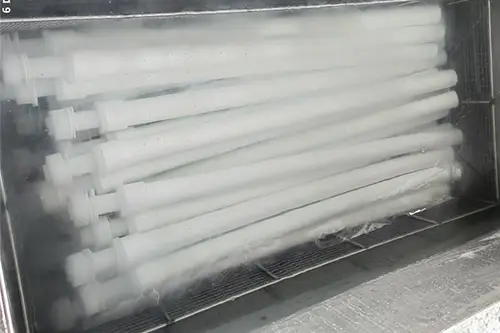
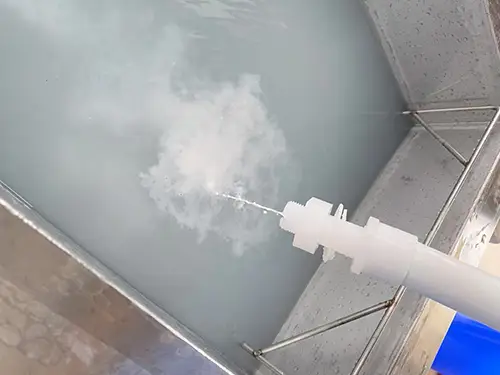
When using ultrasonic vibratory cleaning of PTFE (polytetrafluoroethylene) sintered filter cartridges, a combination of material properties, cleaning efficiency, and cartridge structural integrity need to be considered. The following step-by-step instructions and recommendations:
1. Cleaning standards and specifications
a. Industry reference standards
ASTM E2896: A method of evaluating the cleanliness of filtration equipment involving reference to contaminant residue limits.
ISO 9001/13485: Validation requirements for cleaning processes in quality management systems.
b. Cleaning Objectives
Remove particles, organic matter and chemical residues while maintaining pore structure and mechanical strength.
2. Cleaning Methods and Steps of PTFE filter cartridges
a. Pre-treatment
Mechanical rinsing: Backflush the surface of the filter element with low-pressure water flow to remove large particles of contaminants.
Solvent immersion: For stubborn pollutants (such as grease), soak in a compatible solvent (such as isopropyl alcohol) for 30 minutes to 2 hours.
b. Ultrasonic cleaning parameters
Frequency Selection
Low frequency (20-40 kHz): strong cavitation effect, suitable for removing large particles of contaminants, but may damage the fragile structure.
High frequency (80-120 kHz): gentle cavitation, suitable for fine cleaning, recommended for PTFE cartridges (to reduce the risk of structural damage).
Temperature control
PTFE is resistant to high temperature, but it is recommended that the cleaning solution temperature ≤ 60 ℃, to avoid thermal expansion leading to microporous deformation.
4. low-pressure air drying + air drying at room temperature for 12 hours
5. Perform bubble point test to confirm the integrity of the cartridge.
5. Common Problems
Incomplete cleaning: Extend pretreatment time or replace with a more potent but compatible solvent.
Cartridge whitening/deformation: may be due to high temperature or improper frequency, parameters need to be adjusted.
Through the above methods, effective cleaning can be realized without damaging the PTFE filter cartridge. In practice, it is necessary to optimize the parameters with the specific type of contamination and equipment conditions, and periodically verify the cleaning effect.